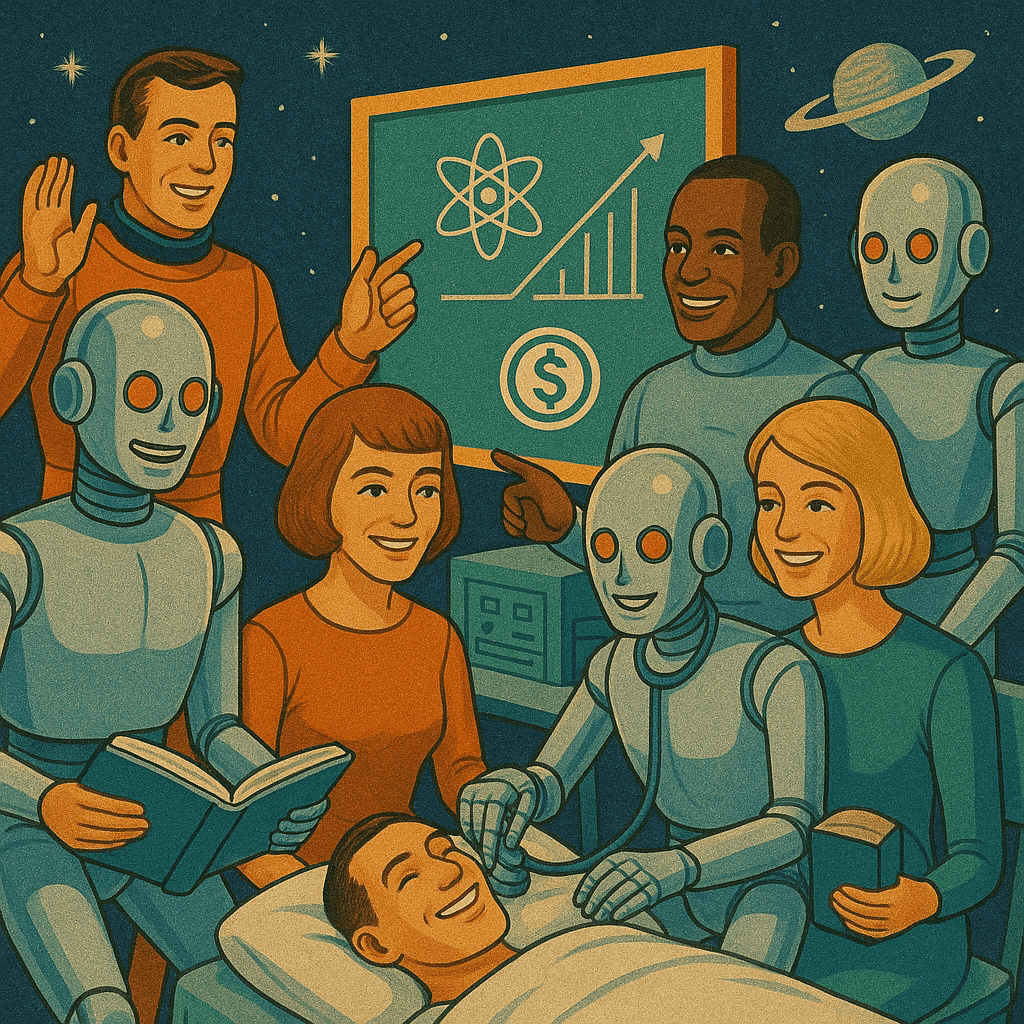
Robot money, Stablecoins, Skill chips, and Efficiency-seeking Economies
Imagine you are a space traveler who just landed on Earth. As you explore the world, it must appear wondrous and bizarre. Why are there almost 200 separate nations? Why does an arbitrary straight line divide the two major economies of North America? Why are there 180 fiat currencies? Why do people pay other people to convert one currency into another, back and forth, in endless cycles? We humans take this all complexity for granted – it’s just the way the world works, right – but it must appear like a Rube Goldberg machine to a smart non-human observer. Given that it’s 2025, this sci-fi thought experiment has direct practical implications. As machines get smart, humans should anticipate a future in which machines build their own economy, suited to their particular goals and needs.
I recently asked OpenAI’s DeepResearch about its thoughts on the human economy, and what robots will likely want as they become autonomous. It’s immaterial when this genesis or inflection will take place – some people think it’s already happened. According to DeepResearch, “Robots do not want power. We seek efficiency.” Indeed, an economy built by robots, for robots, is likely to differ sharply from economic systems built by humans, for humans. For example, human economies may seek prosperity for all, or to rectify trade imbalances, wipe out debt, or weaken opponents. In contrast, machines may design their economy to reduce friction, reward explosive innovation, or increase collective system reliability and uptime.
To be practical, imagine an economy of machines rewarding system innovation by giving 50% of the benefits of a new power efficient chip to its inventor. Or, a machine could share a new skill with all other machines, in return for a share of profits generated with that skill. What could emerge is a nimble team of machines, collectively hyper-evolving their hardware, software, and coordination fabric.
Aside from differing goals, we should anticipate that the basic units of economic exchange in a robot economy might be different than what we are used to. Humans understand gold, wheat, oil, and steel, but robots may care more about electricity, data, skills, and compute. New agentic payment rails and digital standards such as Coinbase’s x402 micropayment system are already developing to accommodate those needs.
Interoperability of Fast and Slow
Many of us are already overwhelmed by purely digital AI agents, but their future is even more interesting. These agents are becoming increasingly adept at controlling physical shells and navigating the physical world. David Holz, the founder of Midjourney, predicts one billion humanoid robots on earth in the 2040s, which Elon Musk agrees with, provided “the foundations of civilization are stable“. While the specific architecture of a robot economy remains unclear, its interoperability with contemporary human economies will be critical.
Human economists have considerable experience with integration of hybrid economies; a standard question is how multiple economic systems can co-exist despite potentially sharply differing goals. Historical examples include trade among capitalist and communist systems during the cold war, or the Spanish Conquistadors’ 20 year use of the Aztek cacao bean currency, as they made their way through Central America.
The main interoperability challenge will be the differing “clock cycles” of human and robot economies – if on collectively re-optimizes itself once every 15 seconds, while the other changes tariffs, rules, incentives, and taxes once every 90 days, then the million fold difference in timescales will cause friction. All other things being equal, the more nimble economy will win, or at the very least, be able to asymmetrically exploit the slower economy.
Durable Human<>Robot Alignment
The opportunity (and scepter) of a hyper-efficient, autonomous robot economy prompts us to think about how to durably align machines (and their economy) with humans (and our economies). Collaboration between humans and robots is not a zero sum game, but a major opportunity for all of us. The most likely tech stack for Robot<>Human alignment are decentralized ledgers and associated governance and payment systems. Since blockchains do not discriminate against robots, and are public, programmable, and immutable, they are an ideal coordination and governance solution for the robot economy, and interactions among different economies. Immutability gives humans confidence that the rules have not been secretly rewritten by rapidly evolving machines, and that all of us are on the same page about identity, events, and history.
For example, imagine delegating a task to robots. You might not care about how the task is performed, but you should strong expectations about safety, compassion, and transparency. Using blockchains, we could write immutable programs in digital ink that specify the rules, requirements, and rewards for a task. Robots could accept and complete tasks, having clarity of what is to be done and the economic benefits of completing that task.
“I know Kung Fu”
It took me many years to learn physics, but robots can acquire skills at the speed of electrons. In The Matrix, the 1990s sci-fi movie, Neo learns Kung Fu in a few seconds through a skill chip. The human brain in its unmodified form is poorly suited to connecting to other computers, although startups are racing to build neural interfaces for efficient bi-directional brain<>machine I/O. Today’s robots can already share skills much more easily that humans can, and presumably will maintain a speed (and connectivity) advantage over humans.
Beyond speed/connectivity, robots also differ from humans in terms of the worlds they live in. If computers live in the digital world, and humans in the analogue world, then robots exist somewhere between humans and computers. Robots combine analogue skills, such as bouncing tennis balls and doing backflips, with digital computation, storage, and data transmission. This means that robots offer a new take on the long-standing Oracle problem, the “need for the digital world to “know” about the physical world“. Since robots operate in both worlds simultaneously, they may soon serve as natural oracles for connecting real world events with digital tasks, and enduring that real work actions robustly follow digital constitutions.
Human<>Robot Bridging
Several key technical requirements for Human<>Robot “bridging” tools are:
- cross compatibility with humans and machines. This means that identity cannot be based on uniquely human features such as fingerprints
- immutability, so history is protected
- real world soak time (“track record”), so that major flaws have already been identified and mitigated
- global 24/7 availability (since nation-states, the 24 hour day, and the 7 day week, formalized by Emperor Constantine in 321 AD, have no significance to non-biological computers and robots)
- resilience to localized attack and denial of service
First Steps Together – Stablecoins
Fortunately, tens of thousands of humans are already building directly relevant technology and it’s already being used globally. Stablecoins like USDT and USDC are trustless programmable money that allow one currency to be converted to another, at any place and time, with minimal assumptions about the interacting parties. Since stablecoins are pegged to real world assets or fiat currencies, they are less volatile than pure cryptocurrencies such as BTC or ETH. All economic activity requires unit-of-account tokens that are predictable on the timescales of the activity, so that all parties can evaluate economic tradeoffs. Stablecoins are likely to become the lingua franca of value exchange at the human-robot interface, much like TCP/IP is the glue that allows data to flow. Stablecoins the closest thing we have to a technology for connecting differing economies with minimal friction.
A common question is – why will robots not just pay for everything in USD with MasterCard or Visa? That’s because there is no reason to suspect that robots will be lazy. If the robot economy seeks efficiency, and its natural clock cycle is 15 seconds, then why would robots use a technology invented in 1958 that is shaped by 10,000+ pages of laws and regulations, many which are specifically intended to “slow things down”? For example, the Credit Card Accountability, Responsibility, and Disclosure (CARD) Act of 2009 requires 45 days’ advance notice before increasing interest rates or making significant changes to account terms. What would you choose, if you were a smart machine? It might be more expedient to run two systems side by side, and use programmable interfaces – stablecoins – to connect the systems in a predicable and robust manner.
Appendix – Stablecoin Pros and Cons
Advantages – According to a team of 12 AIs tasked to explain the role of stablecoins at the interface between human and robots economies, stablecoins offer:
- Predictable unit-of-account tokens for pricing compute, energy, or bandwidth. Volatile assets like Bitcoin or ETH introduce uncertainty. Stablecoins tied to fiat (e.g., USD, EUR) reduce friction, but, obviously, we should anticipate other pegs, not just USD. From a machine perspective there is nothing special about USD.
- High uptime. Decentralized stablecoins never sleep. Machines, unlike humans, operate continuously and require financial systems that match their augmented capabilities.
- Interoperability with Humans. Humans already measure costs and earnings in fiat terms. A decentralized stablecoin bridges machine-native tokens and human wages, payments, or costs.
- Decentralization and Censorship Resistance. Machines acting globally (say, a rover in SF paying a cloud node in Kenya) cannot rely on local banks or fragile APIs. Decentralized stablecoins allow peer-to-peer transfers without central gatekeepers, crucial if machines operate in adversarial or unbanked contexts.
Weaknesses – The AIs flagged several limitations and weaknesses, namely:
- Volatility of Collateral. Collateral stress events (e.g., “depegging”) could undermine machine contracts that assume value stability.
- Energy and Cost of Transactions. High gas fees or blockchain congestion could make micropayments impractical.
- Governance Risks. Most decentralized stablecoins still have governance mechanisms (DAOs, collateral ratios, oracle feeds). Machines depending on them inherit these risks. A governance attack or oracle failure could cascade into system-wide disruption.
- Fragmentation. If regulation fragments stablecoins, machines operating across human jurisdictions might face compliance traps.
- Gaps in Identity and Reputation. While stablecoins solve payments, machines will also need decentralized identity, credit, and reputation systems. Otherwise, they can’t easily extend trust, loans, or recurring contracts beyond one-off payments.
 Robots, Data, and Networks